Autism Spectrum Disorder Awareness
A User Friendly Guide to Supporting Adolescents (13-18 Years Old) with Autism Spectrum Disorder

Welcome! Upon navigating this site, relevant information on adolescents with autism is displayed to help parents, caregivers, families, and even friends understand more about the diagnosis of Autism Spectrum Disorder (ASD) and ways in which they, themselves can help support their loved one. There will also be information on how occupational therapy (OT) can help provide a smooth transition through developmental stages and significantly help those with this diagnosis. The profession is client-focused, and leads clients to live the most fulfilling life they can imagine. We, as OT practitioners, will talk about the Occupational Therapy Practice Framework 4th Edition (OTPF-4) and how the profession applies it to therapy sessions with those with ASD. Persons affected with ASD do not require OT services, but it greatly enhances the way in which they lead their life. Click through the tabs and read to find more information than you ever imagined!
Published by: Alyssa Guenthner
August 1, 2023

Information to be Found:
We offer various information on adolescents with ASD, but most of this information can also be used through the lifespan of someone with this diagnosis. Here you will find:-Typical milestones and role expectations of adolescents aged 13-18 as well as transitional issues to watch out for
-How ASD impacts the developmental process
-Assistive devices and accommodations available to help these teens be successful
-Remedial activities to use to help develop and improve their skills
-A list of community resources and services available to support these adolescents and their families
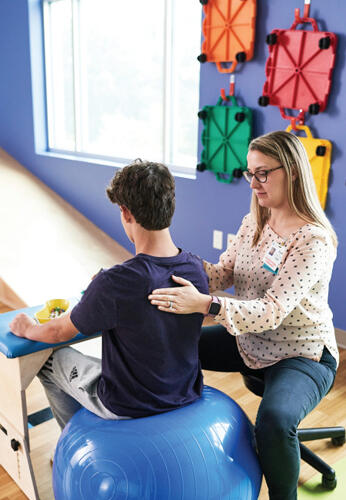
What is Occupational Therapy and how can it Support Teens with Autism?
"Occupational therapy is the therapeutic use of everyday tasks, activities, and occupations
of persons, groups, and populations through participation" (American Occupational Therapy Association, 2020). The profession aims at leading people to live their most healthy and fulfilling life; whether it is through teaching, rehabilitation, or adaptation. OT is client-focused, meaning practitioners follow the lead of the client and what they want to achieve.There are multiple ways in which OT helps and supports adolscents with autism. Some ways include:-Implementing emotional development
-Implementing self-regulation tactics
-Improving self-care routines
-Encouraging social participation
-Improving gross and fine motor skills
Information Retrieved From:
21 Interesting And Fun Activities For Teenagers With Autism. (2015, September 7). MomJunction. https://www.momjunction.com/articles/activities-for-teenagers-with-autism_00371127/(2023). Aota.org. https://www.aota.org/practice/practice-essentials/ot-and-ota-intraprofessional-collaborationAbout Us - Autism Alliance of Northern NY. (n.d.). Www.aaneny.org. Retrieved July 23, 2023, from https://www.aaneny.org/about-usAmerican Occupational Therapy Association. (2020). Occupational therapy practice framework: Domain and process. American Journal of Occupational Therapy, 74(4). https://doi.org/10.5014/ajot.2020.74s2001Autism Sports Programs NYC | United States. (n.d.). Play4Autism. Retrieved July 24, 2023, from https://www.play4autism.org/Definition of occupational therapy practice for the Aota Model Practice Act. (n.d.). https://www.aota.org/-/media/Corporate/Files/Advocacy/State/Resources/PracticeAct/OT-Definition-for-AOTA-Model-Practice-Act.pdfGreatSchools Staff Updated: November 28, 2022 Print article. (2022, November 28). Child development: 13- to 16-year-olds. Parenting. https://www.greatschools.org/gk/articles/child-development-13-to-16-year-olds/Growth and Development, Ages 18 and Over-What Parents Need to Know. (2008, November 17). Advocates for Youth. https://www.advocatesforyouth.org/resources/health-information/parents-17/Morin, A. (2019, August 6). Examples of Assistive Technology and Adaptive Tools in the Classroom. Understood. https://www.understood.org/en/articles/examples-of-assistive-technology-adaptive-toolsMozafaripour, S. (2020, August 18). A guide to occupational therapy for autism: USAHS: USAHS. University of St. Augustine for Health Sciences. https://www.usa.edu/blog/occupational-therapy-for-autism/#::text=Common%20Occupational%20Therapy%20Interventions%20for%20Autism&text=Implementing%20emotional%20development%20and%20self,bathing%2C%20feeding%2C%20and%20grooming.The Autism Society Greater Hudson Region, New York. (2023, September 23). Autism Society Greater Hudson Region. https://asghr.org/Wieder, S. (2018, April 18). Motor Development: How Autism Affects Motor Skills. Profectum Foundation | Autism Resources. https://profectum.org/motor-development-autism-affects-motor-skills/#::text=studying%20motor%20skills.-Journals:Bagatell, N. (2016). The Routines and Occupations of Families With Adolescents With Autism Spectrum Disorders. Focus on Autism and Other Developmental Disabilities, 31(1), 49–59. https://doi.org/10.1177/1088357615587503Brosnan, M., Lewton, M., & Ashwin, C. (2016). Reasoning on the Autism Spectrum: A Dual Process Theory Account. Journal of Autism and Developmental Disorders, 46(6), 2115–2125. https://doi.org/10.1007/s10803-016-2742-4Crippa, A., Forti, S., Perego, P., & Molteni, M. (2012). Eye-Hand Coordination in Children with High Functioning Autism and Asperger’s Disorder Using a Gap-Overlap Paradigm. Journal of Autism and Developmental Disorders, 43(4), 841–850. https://doi.org/10.1007/s10803-012-1623-8Fuentes, C. T., Mostofsky, S. H., & Bastian, A. J. (2009). Children with autism show specific handwriting impairments. Neurology, 73(19), 1532–1537. https://doi.org/10.1212/wnl.0b013e3181c0d48cGanz, J. B., Hong, E. R., Leuthold, E., & Yllades, V. (2019). Naturalistic Augmentative and Alternative Communication Instruction for Practitioners and Individuals With Autism. Intervention in School and Clinic, 55(1), 58–64. https://doi.org/10.1177/1053451219833012Ikuta, N., Iwanaga, R., Tokunaga, A., Nakane, H., Tanaka, K., & Tanaka, G. (2016). Effectiveness of Earmuffs and Noise-cancelling Headphones for Coping with Hyper-reactivity to Auditory Stimuli in Children with Autism Spectrum Disorder: A Preliminary Study. Hong Kong Journal of Occupational Therapy, 28(1), 24–32. https://doi.org/10.1016/j.hkjot.2016.09.001Lecciso, F., Levante, A., Fabio, R. A., Caprì, T., Leo, M., Carcagnì, P., Distante, C., Mazzeo, P. L., Spagnolo, P., & Petrocchi, S. (2021). Emotional Expression in Children With ASD: A Pre-Study on a Two-Group Pre-Post-Test Design Comparing Robot-Based and Computer-Based Training. Frontiers in Psychology, 12. https://doi.org/10.3389/fpsyg.2021.678052Li, D., Larsen, L., Yang, Y., Wang, L., Zhai, Y., & Sullivan, W. C. (2019). Exposure to nature for children with autism spectrum disorder: Benefits, caveats, and barriers. Health & Place, 55, 71–79. https://doi.org/10.1016/j.healthplace.2018.11.005Nuske, H. J., Pellecchia, M., Kane, C., Seidman, M., Maddox, B. B., Freeman, L. M., Rump, K., Reisinger, E. M., Xie, M., & Mandell, D. S. (2020). Self-regulation is bi-directionally associated with cognitive development in children with autism. Journal of Applied Developmental Psychology, 68, 101139. https://doi.org/10.1016/j.appdev.2020.101139Recognising, understanding and managing emotions: autistic children and teenagers. (n.d.). Raising Children Network. https://raisingchildren.net.au/autism/development/social-emotional-development/recognising-understanding-emotions-autistic-children-teens#:~:text=Autistic%20pre%2Dteens%20and%20teenagers%20might%20know%20the%20words%20forRidderinkhof, A., de Bruin, E. I., van den Driesschen, S., & Bögels, S. M. (2018). Attention in Children With Autism Spectrum Disorder and the Effects of a Mindfulness-Based Program. Journal of Attention Disorders, 24(5), 108705471879742. https://doi.org/10.1177/1087054718797428Steinberg L. Cognitive and affective development in adolescence. Trends Cogn Sci. 2005 Feb;9(2):69-74. doi: 10.1016/j.tics.2004.12.005. PMID: 15668099.Vale, A. P., Fernandes, C., & Cardoso, S. (2022). Word reading skills in autism spectrum disorder: A systematic review. Frontiers in Psychology, 13. https://doi.org/10.3389/fpsyg.2022.930275

Typical Development


What is the Developmental Sequence?
The developmental sequence is a series of changes in structure and functions that all people must go through in order to develop completely. There are milestones that should be reached by each age, and role expectations of each age range. Here are typical milestones and role expectations for ages 13-18:
AGES 13-14:
At these ages, adolescents are very self-centric. Most of these teens think the world revolves around them which can result in them being overly self-conscious. These adolescents want to fit in and not be an outcast; they want friends and to hang out with their friends. They are starting to become more independent and develop their own personality; finding who they really are and what they like to do.
Cognitively, their problem-solving skills are still developing rapidly yet they have difficulty thinking about the future and what's to come. They tend to not think about how their actions have consequences before they act, even though they know this concept. Along with this, they know what is right and what is wrong, yet continuously push limits. They are now beginning to understand abstract concepts such as faith and trust which develops their own morals.Here is a list of performance patterns, performance skills, and client factors that typical developing 13-14 year-olds possess:
| Performance Patterns | |
|---|---|
| Habits | “Specific, automatic behaviors performed repeatedly, relatively automatically, and with little variation” (Matuska & Barrett, 2019, p. 214). Habits can be healthy or unhealthy, efficient or inefficient, and supportive or harmful (Dunn, 2000). |
| Routines | Patterns of behavior that are observable, regular, and repetitive and that provide structure for daily life. They can be satisfying, promoting, or damaging. Routines require delimited time commitment and are embedded in cultural and ecological contexts (Fiese, 2007; Segal, 2004). |
| Roles | Aspects of identity shaped by culture and context that may be further conceptualized and defined by the client and the activities and occupations one engages in. |
Retrieved from (OTPF-4, 2020, pg. 41)
| Performance Skills | |
|---|---|
| Coordinates | Uses two or more body parts together to manipulate and hold task objects without evidence of fumbling or task objects slipping from the grasp |
| Moves | Effectively pushes or pulls task objects along a supporting surface, pulls to open or pushes to close doors and drawers, or pushes on wheels to propel a wheelchair |
| Walks | During task performance, ambulates on level surfaces without shuffling feet, becoming unstable, propping, or using assistive devices |
| Transports | Carries task objects from one place to another while walking or moving in a wheelchair |
| Endures | Persists and completes the task without demonstrating physical fatigue, pausing to rest, or stopping to catch breath |
| Heeds | Carries out and completes the task originally agreed on or specified by another person |
| Chooses | Selects necessary and appropriate type and number of objects for the task, including the task objects that one chooses or is directed to use (e.g., by a teacher) |
| Handles | Supports or stabilizes task objects appropriately, protecting them from being damaged, slipping, moving, or falling |
| inquires | (1) Seeks needed verbal or written information by asking questions or reading directions or labels and (2) does not ask for information when fully oriented to the task and environment and recently aware of the answer |
| Initiates | Starts or begins the next task action or task step without any hesitation |
| Continues | Performs single actions or steps without any interruptions so that once an action or task step is initiated, performance continues without pauses or delays until the action or step is completed |
| Sequences | Performs steps in an effective or logical order and with an absence of randomness in the ordering or inappropriate repetition of steps |
| Searches/Locates | Looks for and locates task objects in a logical manner |
| Navigates | Moves body or wheelchair without bumping into obstacles when moving through the task environment or interacting with task objects |
| Notices/responds | Responds appropriately to (1) nonverbal task-related cues (e.g., heat, movement), (2) the spatial arrangement and alignment of task objects to one another, and (3) cupboard doors or drawers that have been left open during task performance |
| Produces speech | Produces spoken, signed, or augmentative (i.e., computer-generated) messages that are audible and clearly articulated |
| Turns toward | Actively positions or turns body and face toward the social partner or the person who is speaking |
| Looks | Makes eye contact with the social partner |
| Touches | Responds to and uses touch or bodily contact with the social partner in a socially appropriate manner |
| Questions | Requests relevant facts and information and asks questions that support the intended purpose of the social interaction |
| Replies | Keeps conversation going by replying appropriately to suggestions, opinions, questions, and comments |
| Disagrees | Expresses differences of opinion in a socially appropriate manner |
| Thanks | Uses appropriate words and gestures to acknowledge receipt of services, gifts, or compliments |
| Times response | Replies to social messages without delay or hesitation and without interrupting the social partner |
| Takes turns | Speaks in turn and gives the social partner the freedom to take their turn |
Retrieved from (OTPF-4, 2020, pgs.43-49)
| Client Factors | |
|---|---|
| Higher level cognitive | Judgment, concept formation, metacognition, executive functions, praxis, cognitive flexibility, insight |
| Attention | Sustained shifting and divided attention, concentration, distractibility |
| Memory | Short-term, long-term, and working memory |
| Perception | Discrimination of sensations (e.g., auditory, tactile, visual, olfactory, gustatory, vestibular, proprioceptive) |
| Thought | Control and content of thought, awareness of reality vs. delusions, logical and coherent thought |
| Mental functions of sequencing complex movement | Mental functions that regulate the speed, response, quality, and time of motor production, such as restlessness, toe tapping, or hand wringing, in response to inner tension |
| Experience of self and time | Awareness of one’s identity (including gender identity), body, and position in the reality of one’s environment and of time |
| Energy | Energy level, motivation, appetite, craving, impulse |
| Sleep | Physiological process, quality of sleep |
| Visual functions | Quality of vision, visual acuity, visual stability, and visual field functions to promote visual awareness of environment at various distances for functioning |
| Hearing functions | Sound detection and discrimination; awareness of location and distance of sounds |
| Taste Functions | Association of taste qualities of bitterness, sweetness, sourness, and saltiness |
| Proprioceptive functions | Awareness of body position and space |
| Interoception | Internal detection of changes in one’s internal organs through specific sensory receptors (e.g., awareness of hunger, thirst, digestion, state of alertness) |
| Sensitivity to temperature and pressure | Thermal awareness (hot and cold), sense of force applied to skin |
| Involutary movement reactions | Postural reactions, body adjustment reactions, supporting reactions |
| Control of voluntary movement | Eye–hand and eye–foot coordination, bilateral integration, crossing of the midline, fine and gross motor control, oculomotor function (e.g., saccades, pursuits, accommodation, binocularity) |
Retrieved from (OTPF-4, 2020, pgs.52-53)
AGES 15-16:
At these ages, mood swings are a common theme at 15-16 and they can go from being sweet and loving one minute to quarrelsome the next. One day they can feel extremely confident in themselves, the next they feel very self-conscious. As stated by professionals, "Adolescence is often a period of especially heightened vulnerability as a consequence of potential disjunctions between developing brain, behavioral and cognitive systems that mature along different timetables and under the control of both common and independent biological processes." (Steinberg 2004). It is a difficult time to get through for both the teenager and the caregiver, but the important thing is to remember that these things are normal and it is all part of development.
At 15-16, teenagers are focused on the present rather than the future and the possibilities to come. However, as they near the end of 16, that focus on the future does begin to develop.Other cognitive changes happening at this time are:
-Reasoning and decision-making skills improve
-Learns to use deductive reasoning and make educated guesses
-Recognize that actions in the present can impact the future
-Morals continue to develop and get stronger
-Learns to distinguish fact from opinion
-Challenges opinions of adultsHere is a list of performance patterns, performance skills, and client factors that typical developing 15-16 year-olds possess:
| Performance Patterns | |
|---|---|
| Habits | “Specific, automatic behaviors performed repeatedly, relatively automatically, and with little variation” (Matuska & Barrett, 2019, p. 214). Habits can be healthy or unhealthy, efficient or inefficient, and supportive or harmful (Dunn, 2000). |
| Routines | Patterns of behavior that are observable, regular, and repetitive and that provide structure for daily life. They can be satisfying, promoting, or damaging. Routines require delimited time commitment and are embedded in cultural and ecological contexts (Fiese, 2007; Segal, 2004). |
| Roles | Aspects of identity shaped by culture and context that may be further conceptualized and defined by the client and the activities and occupations one engages in. |
Retrieved from (OTPF-4, 2020, pg. 41)
| Performance Skills | |
|---|---|
| Coordinates | Uses two or more body parts together to manipulate and hold task objects without evidence of fumbling or task objects slipping from the grasp |
| Moves | Effectively pushes or pulls task objects along a supporting surface, pulls to open or pushes to close doors and drawers, or pushes on wheels to propel a wheelchair |
| Walks | During task performance, ambulates on level surfaces without shuffling feet, becoming unstable, propping, or using assistive devices |
| Transports | Carries task objects from one place to another while walking or moving in a wheelchair |
| Endures | Persists and completes the task without demonstrating physical fatigue, pausing to rest, or stopping to catch breath |
| Heeds | Carries out and completes the task originally agreed on or specified by another person |
| Chooses | Selects necessary and appropriate type and number of objects for the task, including the task objects that one chooses or is directed to use (e.g., by a teacher) |
| Handles | Supports or stabilizes task objects appropriately, protecting them from being damaged, slipping, moving, or falling |
| inquires | (1) Seeks needed verbal or written information by asking questions or reading directions or labels and (2) does not ask for information when fully oriented to the task and environment and recently aware of the answer |
| Initiates | Starts or begins the next task action or task step without any hesitation |
| Continues | Performs single actions or steps without any interruptions so that once an action or task step is initiated, performance continues without pauses or delays until the action or step is completed |
| Organizes | Logically positions or spatially arranges task objects in an orderly fashion within a single work space or between multiple appropriate work spaces such that the work space is not too spread out or too crowded |
| Sequences | Performs steps in an effective or logical order and with an absence of randomness in the ordering or inappropriate repetition of steps |
| Searches/Locates | Looks for and locates task objects in a logical manner |
| Navigates | Moves body or wheelchair without bumping into obstacles when moving through the task environment or interacting with task objects |
| Notices/responds | Responds appropriately to (1) nonverbal task-related cues (e.g., heat, movement), (2) the spatial arrangement and alignment of task objects to one another, and (3) cupboard doors or drawers that have been left open during task performance |
| Produces speech | Produces spoken, signed, or augmentative (i.e., computer-generated) messages that are audible and clearly articulated |
| Gesticulates | Uses socially appropriate gestures to communicate or support a message |
| Speaks fluently | Speaks in a fluent and continuous manner, with an even pace (not too fast, not too slow) and without pauses or delays, while sending a message |
| Turns toward | Actively positions or turns body and face toward the social partner or the person who is speaking |
| Looks | Makes eye contact with the social partner |
| Places self | Positions self at an appropriate distance from the social partner |
| Touches | Responds to and uses touch or bodily contact with the social partner in a socially appropriate manner |
| Questions | Requests relevant facts and information and asks questions that support the intended purpose of the social interaction |
| Replies | Keeps conversation going by replying appropriately to suggestions, opinions, questions, and comments |
| Discloses | Reveals opinions, feelings, and private information about self or others in a socially appropriate manner |
| Expresses emotions | Displays affect and emotions in a socially appropriate manner |
| Disagrees | Expresses differences of opinion in a socially appropriate manner |
| Thanks | Uses appropriate words and gestures to acknowledge receipt of services, gifts, or compliments |
| Times response | Replies to social messages without delay or hesitation and without interrupting the social partner |
| Takes turns | Speaks in turn and gives the social partner the freedom to take their turn |
| Matches language | Uses a tone of voice, dialect, and level of language that are socially appropriate and matched to the social partner’s abilities and level of understanding |
Retrieved from (OTPF-4, 2020, pgs.43-49)
| Client Factors | |
|---|---|
| Higher level cognitive | Judgment, concept formation, metacognition, executive functions, praxis, cognitive flexibility, insight |
| Attention | Sustained shifting and divided attention, concentration, distractibility |
| Memory | Short-term, long-term, and working memory |
| Perception | Discrimination of sensations (e.g., auditory, tactile, visual, olfactory, gustatory, vestibular, proprioceptive) |
| Thought | Control and content of thought, awareness of reality vs. delusions, logical and coherent thought |
| Mental functions of sequencing complex movement | Mental functions that regulate the speed, response, quality, and time of motor production, such as restlessness, toe tapping, or hand wringing, in response to inner tension |
| Experience of self and time | Awareness of one’s identity (including gender identity), body, and position in the reality of one’s environment and of time |
| Energy | Energy level, motivation, appetite, craving, impulse |
| Sleep | Physiological process, quality of sleep |
| Visual functions | Quality of vision, visual acuity, visual stability, and visual field functions to promote visual awareness of environment at various distances for functioning |
| Hearing functions | Sound detection and discrimination; awareness of location and distance of sounds |
| Taste Functions | Association of taste qualities of bitterness, sweetness, sourness, and saltiness |
| Proprioceptive functions | Awareness of body position and space |
| Interoception | Internal detection of changes in one’s internal organs through specific sensory receptors (e.g., awareness of hunger, thirst, digestion, state of alertness) |
| Sensitivity to temperature and pressure | Thermal awareness (hot and cold), sense of force applied to skin |
| Involutary movement reactions | Postural reactions, body adjustment reactions, supporting reactions |
| Control of voluntary movement | Eye–hand and eye–foot coordination, bilateral integration, crossing of the midline, fine and gross motor control, oculomotor function (e.g., saccades, pursuits, accommodation, binocularity) |
Retrieved from (OTPF-4, 2020, pgs.52-53)
AGE 17:
At 17, adolescents are close to being legal adults and have a strong sense of who they are. They are now able to focus on the future and what they want from life after high school. This is a result of being goal-oriented and having a strong desire to succeed. They now feel responsibility and have a fear of failing. At this point in their lives, they are now able to hold close friendships rather than going back and forth between friends. A large part of this is that they are able to form and honor commitments due to their sense of morals. Although they may still be impulsive, they are able to think about what they have done and try to fit it.Here is a list of performance patterns, performance skills, and client factors that typical developing 17 year-olds possess:
| Performance Patterns | |
|---|---|
| Habits | “Specific, automatic behaviors performed repeatedly, relatively automatically, and with little variation” (Matuska & Barrett, 2019, p. 214). Habits can be healthy or unhealthy, efficient or inefficient, and supportive or harmful (Dunn, 2000). |
| Routines | Patterns of behavior that are observable, regular, and repetitive and that provide structure for daily life. They can be satisfying, promoting, or damaging. Routines require delimited time commitment and are embedded in cultural and ecological contexts (Fiese, 2007; Segal, 2004). |
| Roles | Aspects of identity shaped by culture and context that may be further conceptualized and defined by the client and the activities and occupations one engages in. |
Retrieved from (OTPF-4, 2020, pg. 41)
| Performance Skills | |
|---|---|
| Coordinates | Uses two or more body parts together to manipulate and hold task objects without evidence of fumbling or task objects slipping from the grasp |
| Moves | Effectively pushes or pulls task objects along a supporting surface, pulls to open or pushes to close doors and drawers, or pushes on wheels to propel a wheelchair |
| Walks | During task performance, ambulates on level surfaces without shuffling feet, becoming unstable, propping, or using assistive devices |
| Transports | Carries task objects from one place to another while walking or moving in a wheelchair |
| Endures | Persists and completes the task without demonstrating physical fatigue, pausing to rest, or stopping to catch breath |
| Heeds | Carries out and completes the task originally agreed on or specified by another person |
| Chooses | Selects necessary and appropriate type and number of objects for the task, including the task objects that one chooses or is directed to use (e.g., by a teacher) |
| Handles | Supports or stabilizes task objects appropriately, protecting them from being damaged, slipping, moving, or falling |
| inquires | (1) Seeks needed verbal or written information by asking questions or reading directions or labels and (2) does not ask for information when fully oriented to the task and environment and recently aware of the answer |
| Initiates | Starts or begins the next task action or task step without any hesitation |
| Continues | Performs single actions or steps without any interruptions so that once an action or task step is initiated, performance continues without pauses or delays until the action or step is completed |
| Organizes | Logically positions or spatially arranges task objects in an orderly fashion within a single work space or between multiple appropriate work spaces such that the work space is not too spread out or too crowded |
| Sequences | Performs steps in an effective or logical order and with an absence of randomness in the ordering or inappropriate repetition of steps |
| Searches/Locates | Looks for and locates task objects in a logical manner |
| Navigates | Moves body or wheelchair without bumping into obstacles when moving through the task environment or interacting with task objects |
| Notices/responds | Responds appropriately to (1) nonverbal task-related cues (e.g., heat, movement), (2) the spatial arrangement and alignment of task objects to one another, and (3) cupboard doors or drawers that have been left open during task performance |
| Produces speech | Produces spoken, signed, or augmentative (i.e., computer-generated) messages that are audible and clearly articulated |
| Gesticulates | Uses socially appropriate gestures to communicate or support a message |
| Speaks fluently | Speaks in a fluent and continuous manner, with an even pace (not too fast, not too slow) and without pauses or delays, while sending a message |
| Turns toward | Actively positions or turns body and face toward the social partner or the person who is speaking |
| Looks | Makes eye contact with the social partner |
| Places self | Positions self at an appropriate distance from the social partner |
| Touches | Responds to and uses touch or bodily contact with the social partner in a socially appropriate manner |
| Questions | Requests relevant facts and information and asks questions that support the intended purpose of the social interaction |
| Replies | Keeps conversation going by replying appropriately to suggestions, opinions, questions, and comments |
| Discloses | Reveals opinions, feelings, and private information about self or others in a socially appropriate manner |
| Expresses emotions | Displays affect and emotions in a socially appropriate manner |
| Disagrees | Expresses differences of opinion in a socially appropriate manner |
| Thanks | Uses appropriate words and gestures to acknowledge receipt of services, gifts, or compliments |
| Times response | Replies to social messages without delay or hesitation and without interrupting the social partner |
| Takes turns | Speaks in turn and gives the social partner the freedom to take their turn |
| Matches language | Uses a tone of voice, dialect, and level of language that are socially appropriate and matched to the social partner’s abilities and level of understanding |
| Clarifies | Responds to gestures or verbal messages from the social partner signaling that the social partner does not comprehend or understand a message and ensures that the social partner is following the conversation |
| Acknowledges and encourages | Acknowledges receipt of messages, encourages the social partner to continue the social interaction, and encourages all social partners to participate in the interaction |
| Empathizes | Expresses a supportive attitude toward the social partner by agreeing with, empathizing with, or expressing understanding of the social partner’s feelings and experiences |
Retrieved from (OTPF-4, 2020, pgs.43-49)
| Client Factors | |
|---|---|
| Higher level cognitive | Judgment, concept formation, metacognition, executive functions, praxis, cognitive flexibility, insight |
| Attention | Sustained shifting and divided attention, concentration, distractibility |
| Memory | Short-term, long-term, and working memory |
| Perception | Discrimination of sensations (e.g., auditory, tactile, visual, olfactory, gustatory, vestibular, proprioceptive) |
| Thought | Control and content of thought, awareness of reality vs. delusions, logical and coherent thought |
| Mental functions of sequencing complex movement | Mental functions that regulate the speed, response, quality, and time of motor production, such as restlessness, toe tapping, or hand wringing, in response to inner tension |
| Experience of self and time | Awareness of one’s identity (including gender identity), body, and position in the reality of one’s environment and of time |
| Energy | Energy level, motivation, appetite, craving, impulse |
| Sleep | Physiological process, quality of sleep |
| Visual functions | Quality of vision, visual acuity, visual stability, and visual field functions to promote visual awareness of environment at various distances for functioning |
| Hearing functions | Sound detection and discrimination; awareness of location and distance of sounds |
| Taste Functions | Association of taste qualities of bitterness, sweetness, sourness, and saltiness |
| Proprioceptive functions | Awareness of body position and space |
| Interoception | Internal detection of changes in one’s internal organs through specific sensory receptors (e.g., awareness of hunger, thirst, digestion, state of alertness) |
| Sensitivity to temperature and pressure | Thermal awareness (hot and cold), sense of force applied to skin |
| Involutary movement reactions | Postural reactions, body adjustment reactions, supporting reactions |
| Control of voluntary movement | Eye–hand and eye–foot coordination, bilateral integration, crossing of the midline, fine and gross motor control, oculomotor function (e.g., saccades, pursuits, accommodation, binocularity) |
Retrieved from (OTPF-4, 2020, pgs.52-53)
AGE 18:
18 is a big year for adolescents. At this age, they are now legal adults and most are graduating high school and entering the real world. they now need to be more independent than before yet still lean on family for support. They now begin to develop adult relationships with their parents and close adults, finally feeling less than a child. They now feel and display more empathy than before as well as showing greater intimacy skills. They have a true sense of who they are and are less likely to be influenced by peers to be something they are not.
As stated before, at this age, adolescents are graduating high school and moving into adult roles. They now truly identify career goals and prepare to achieve them by learning trade, starting to work, or entering college. Along with this, they begin to explore adult interests more and develop skills and hobbies. They are now able to fully comprehend and understand abstract thinking while also being aware of their personal limitations.Here is a list of performance patterns, performance skills, and client factors that typical developing 18 year-olds possess:
| Performance Patterns | |
|---|---|
| Habits | “Specific, automatic behaviors performed repeatedly, relatively automatically, and with little variation” (Matuska & Barrett, 2019, p. 214). Habits can be healthy or unhealthy, efficient or inefficient, and supportive or harmful (Dunn, 2000). |
| Routines | Patterns of behavior that are observable, regular, and repetitive and that provide structure for daily life. They can be satisfying, promoting, or damaging. Routines require delimited time commitment and are embedded in cultural and ecological contexts (Fiese, 2007; Segal, 2004). |
| Roles | Aspects of identity shaped by culture and context that may be further conceptualized and defined by the client and the activities and occupations one engages in. |
Retrieved from (OTPF-4, 2020, pg. 41)
| Performance Skills | |
|---|---|
| Coordinates | Uses two or more body parts together to manipulate and hold task objects without evidence of fumbling or task objects slipping from the grasp |
| Moves | Effectively pushes or pulls task objects along a supporting surface, pulls to open or pushes to close doors and drawers, or pushes on wheels to propel a wheelchair |
| Walks | During task performance, ambulates on level surfaces without shuffling feet, becoming unstable, propping, or using assistive devices |
| Transports | Carries task objects from one place to another while walking or moving in a wheelchair |
| Endures | Persists and completes the task without demonstrating physical fatigue, pausing to rest, or stopping to catch breath |
| Heeds | Carries out and completes the task originally agreed on or specified by another person |
| Chooses | Selects necessary and appropriate type and number of objects for the task, including the task objects that one chooses or is directed to use (e.g., by a teacher) |
| Handles | Supports or stabilizes task objects appropriately, protecting them from being damaged, slipping, moving, or falling |
| inquires | (1) Seeks needed verbal or written information by asking questions or reading directions or labels and (2) does not ask for information when fully oriented to the task and environment and recently aware of the answer |
| Initiates | Starts or begins the next task action or task step without any hesitation |
| Continues | Performs single actions or steps without any interruptions so that once an action or task step is initiated, performance continues without pauses or delays until the action or step is completed |
| Organizes | Logically positions or spatially arranges task objects in an orderly fashion within a single work space or between multiple appropriate work spaces such that the work space is not too spread out or too crowded |
| Sequences | Performs steps in an effective or logical order and with an absence of randomness in the ordering or inappropriate repetition of steps |
| Searches/Locates | Looks for and locates task objects in a logical manner |
| Navigates | Moves body or wheelchair without bumping into obstacles when moving through the task environment or interacting with task objects |
| Notices/responds | Responds appropriately to (1) nonverbal task-related cues (e.g., heat, movement), (2) the spatial arrangement and alignment of task objects to one another, and (3) cupboard doors or drawers that have been left open during task performance |
| Produces speech | Produces spoken, signed, or augmentative (i.e., computer-generated) messages that are audible and clearly articulated |
| Gesticulates | Uses socially appropriate gestures to communicate or support a message |
| Speaks fluently | Speaks in a fluent and continuous manner, with an even pace (not too fast, not too slow) and without pauses or delays, while sending a message |
| Turns toward | Actively positions or turns body and face toward the social partner or the person who is speaking |
| Looks | Makes eye contact with the social partner |
| Places self | Positions self at an appropriate distance from the social partner |
| Touches | Responds to and uses touch or bodily contact with the social partner in a socially appropriate manner |
| Questions | Requests relevant facts and information and asks questions that support the intended purpose of the social interaction |
| Replies | Keeps conversation going by replying appropriately to suggestions, opinions, questions, and comments |
| Discloses | Reveals opinions, feelings, and private information about self or others in a socially appropriate manner |
| Expresses emotions | Displays affect and emotions in a socially appropriate manner |
| Disagrees | Expresses differences of opinion in a socially appropriate manner |
| Thanks | Uses appropriate words and gestures to acknowledge receipt of services, gifts, or compliments |
| Times response | Replies to social messages without delay or hesitation and without interrupting the social partner |
| Takes turns | Speaks in turn and gives the social partner the freedom to take their turn |
| Matches language | Uses a tone of voice, dialect, and level of language that are socially appropriate and matched to the social partner’s abilities and level of understanding |
| Clarifies | Responds to gestures or verbal messages from the social partner signaling that the social partner does not comprehend or understand a message and ensures that the social partner is following the conversation |
| Acknowledges and encourages | Acknowledges receipt of messages, encourages the social partner to continue the social interaction, and encourages all social partners to participate in the interaction |
| Empathizes | Expresses a supportive attitude toward the social partner by agreeing with, empathizing with, or expressing understanding of the social partner’s feelings and experiences |
| Heeds | Uses goal-directed social interactions focused on carrying out and completing the intended purpose of the social interaction |
| Accommodates | Prevents ineffective or socially inappropriate social interaction |
| Benefits | Prevents problems with ineffective or socially inappropriate social interaction from recurring or persisting |
Retrieved from (OTPF-4, 2020, pgs.52-53)

What are the Impacts of ASD?
No caregiver wants to hear that their child has developmental delays due to their disability. However, it is not something that can be controlled as no one chooses to be diagnosed with ASD. While it can not be controlled, severe delay can try to be prevented with the use of occupational therapy at an early age. It is important to remember that even with services, these adolescents will still have developmental issues; just less severe than if they did not receive services.

What to Watch Out For
Performance skills
ASD can have a large impact on motor, process, and social performance skills. Read on to learn about how this diagnosis can affect the development of these skills.
Motor skills
Adolescents with Autism Spectrum Disorder typically have difficulty with motor skills and are often behind their peers' motor abilities. An article reads, "Studies have shown autistic children can have varying degrees of difficulty with fine and gross motor skills. Another study suggests autistic children could be six months behind in gross motor skills compared to their peers, and a year behind in fine motor skills" (Wieder, 2018). These difficulties can be overcome with help such as OT and other types of therapies, but they exist due to the differences in the brain between adolescents with ASD and typical adolescents. These delays can also be caused by their troubles with sensory processing.Gross motor skills include anything dealing with balance, motor control, and body awareness. This includes large movement activities like running, jumping, riding a bike, or even carrying a book. Adolescents with ASD are often clumsy and have issues with coordination, which causes difficulties with their gross motor movements.Fine motor skills include anything that relies on the hand muscles. This includes activities like writing, playing an instrument, brushing teeth, putting on shoes, and dialing a phone. Difficulties with these movements can have a large impact on development and roles as it can make them more dependent on others rather than independent like typical adolescents are becoming at these ages. A lack of fine motor skills impacts their ability to be a student as handwriting is crucial for school. Issues with gross and fine motor skills can be overcome with time and help, such as services with OT.Below is a table of motor skills affected.
| Performance skills | Definition |
|---|---|
| Positions | Positions self an effective distance from task objects and without evidence of awkward arm or body positions |
| Coordinates | Uses two or more body parts together to manipulate and hold task objects without evidence of fumbling or task objects slipping from the grasp |
| Flows | Uses smooth and fluid arm and wrist movements when interacting with task objects |
| Paces | Maintains a consistent and effective rate or tempo of performance throughout the entire task performance |
Retrieved from (OTPF-4, 2020, pgs.43-44)

Social Interaction Skills
As adolescents grow, it is important to watch out for signs of ASD that might be an indication of hindered delay due to the diagnosis. For example, most teenagers 13-18 find conversation easy and simple; able to carry them and understand jokes and tones. However, an adolescent may have difficulty taking turns in conversation and knowing when to respond appropriately. They also tend to take jokes literally, taking everything for exactly what is said. People with ASD also tend to lack eye contact, looking at the ground of even a different body part while their body language looks uncomfortable, even around familiar people. They do not quite grasp the concept of social norms and as a result, are often standing out from their peers because of it.Below is a table from the OTPF-4 of social skills that may be affected:
| Performance skills | Definition |
|---|---|
| Approaches/starts | Approaches or initiates interaction with the social partner in a manner that is socially appropriate |
| Concludes/disengages | Effectively terminates the conversation or social interaction, brings to closure the topic under discussion, and disengages or says goodbye |
| Gesticulates | Uses socially appropriate gestures to communicate or support a message |
| Looks | Makes eye contact with the social partner |
| Turns towards | Actively positions or turns body and face toward the social partner or the person who is speaking |
| Places self | Positions self at an appropriate distance from the social partner |
| Touches | Responds to and uses touch or bodily contact with the social partner in a socially appropriate manner |
| Regulates | Does not demonstrate irrelevant, repetitive, or impulsive behaviors during social interaction |
| Replies | Keeps conversation going by replying appropriately to suggestions, opinions, questions, and comments |
| Expresses emotions | Displays affect and emotions in a socially appropriate manner |
| Transitions | Handles transitions in the conversation or changes the topic without disrupting the ongoing conversation |
| Empathizes | Expresses a supportive attitude toward the social partner by agreeing with, empathizing with, or expressing understanding of the social partner’s feelings and experiences |
Retrieved from (OTPF-4, 2020, pgs.47-49).
Process/Emotional skills
Adolescents usually have a good understanding of how to express themselves. However, people this age with autism might either lash out or completely keep to themselves rather than communicate and expressing themselves. Along with this, they may also have trouble reading and displaying facial expressions. They may not have a good sense of personal space or body posture, often misreading situations or unable to read it at all. For example, a person may be upset and the teen with ASD may take it as the person is angry at them. An article says, "Autistic teenagers might know the words for emotions but still have trouble recognizing them in themselves and others, particularly when they’re upset. They might also have difficulty recognizing other people’s facial expressions, tone of voice or body language" (Recognising, Understanding and Managing Emotions: Autistic Children and Teenagers, n.d.). It is crucial that they have support and help to recognize and understand others' emotions as well as their own.Below is a list of process and emotional skills that may be affected:
| Performance skills | Definition |
|---|---|
| Paces | Maintains a consistent and effective rate or tempo of performance throughout the entire task performance |
| Inquires | (1) Seeks needed verbal or written information by asking questions or reading directions or labels and (2) does not ask for information when fully oriented to the task and environment and recently aware of the answer |
| Continues | Performs single actions or steps without any interruptions so that once an action or task step is initiated, performance continues without pauses or delays until the action or step is completed |
| Sequences | Performs steps in an effective or logical order and with an absence of randomness in the ordering or inappropriate repetition of steps |
| Organizes | Logically positions or spatially arranges task objects in an orderly fashion within a single work space or between multiple appropriate work spaces such that the work space is not too spread out or too crowded |
| Notices/Responds | Responds appropriately to (1) nonverbal task-related cues (e.g., heat, movement), (2) the spatial arrangement and alignment of task objects to one another, and (3) cupboard doors or drawers that have been left open during task performance |
| Adjusts | Overcomes problems with ongoing task performance effectively by (1) going to a new workspace; (2) moving task objects out of the current workspace; or (3) adjusting knobs, dials, switches, or water taps |
| Accommodates | Prevents ineffective performance of all other motor and process skills and asks for assistance only when appropriate or needed |
Retrieved from (OTPF-4, 2020, pgs.43-47)
Performance patterns:
Routines play a large role in ASD as adolescents with ASD need everyday routines in order to stay on task and get things done. Most people with this diagnosis do not like surprises or changes in routine; they do not like the unexpected. A scholarly article reads, "This study adds to the growing literature on the daily life experiences of families with children with ASD by exploring the routines and occupations of families with adolescents with ASD. The results of this study suggest routines continue to play an essential role in enabling families to get things done. These routines are constructed through a transaction of the adolescent with ASD and other family members and are influenced by a multitude of factors" (Bagatell, 2016). The article also discussed how these routines helped enable teens with ASD to carry out their family roles. A routine for the adolescent as well as the entire family encourages the teen to carry out their role as a son/daughter and student by giving them a guide to do chores, do homework, leisure time, etc. Not having a routine can cause changes in behavior, causing them to act out or even slack off from roles and responsibilities. It is essential for routines to be set.Below is a list of specific performance patterns affected:
| Performance patterns | Definition |
|---|---|
| Habits | “Specific, automatic behaviors performed repeatedly, relatively automatically, and with little variation” (Matuska & Barrett, 2019, p. 214). Habits can be healthy or unhealthy, efficient or inefficient, and supportive or harmful (Dunn, 2000). |
| Routines | Patterns of behavior that are observable, regular, and repetitive and that provide structure for daily life. They can be satisfying, promoting, or damaging. Routines require delimited time commitment and are embedded in cultural and ecological contexts (Fiese, 2007; Segal, 2004). |
| Roles | Aspects of identity shaped by culture and context that may be further conceptualized and defined by the client and the activities and occupations one engages in. |
Retrieved from (OTPF-4, 2020, pg.41)
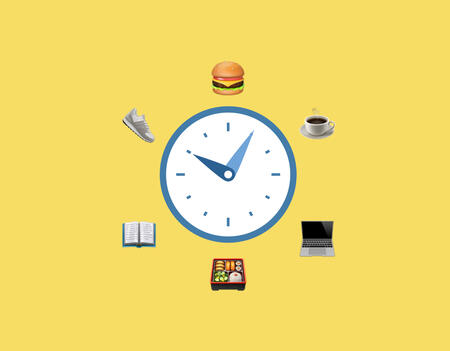

Accommodations and Adaptations
On this tab, you will find out about multiple different devices that can help adolescents with ASD fulfill their roles and accomplish tasks more effectively. Read on to discover about the different devices that can help assist these teens.
Augmentative and Alternative Communication (AAC) Talker Buddy
What is AAC?
AAC is a form of assistive technology that can benefit people with ASD of all ages, especially those in adolescence. It includes any form of communication besides verbally talking out loud. AAC promotes expanding communication, independence, and increasing social interactions. A scholarly journal reads, "Research suggests aided augmentative and alternative communication (AAC) used with young individuals with complex communication needs (CCN) can result in improved communication quality and frequency" (Ganz et al.m 2019). Due to the AAC device making it easier to communicate, these individuals with ASD will have an easier time expressing their emotions and needs.What is the AAC Talker Buddy?
This AAC device is a lightweight and travel-friendly “remote” that consists of soft-touch buttons that can be used to communicate. The device comes with pre-recorded statements but the remote can also be customized with a recording of a loved one’s voice to make the AAC device more personalized. If the child has a hard time communicating, they can use this device to help communicate what they need and how they are feeling. The adolescent needs to understand that the buttons they push will communicate how they are feeling/what they need without verbally communicating themselves as many teens with ASD have difficulties with verbal communication.
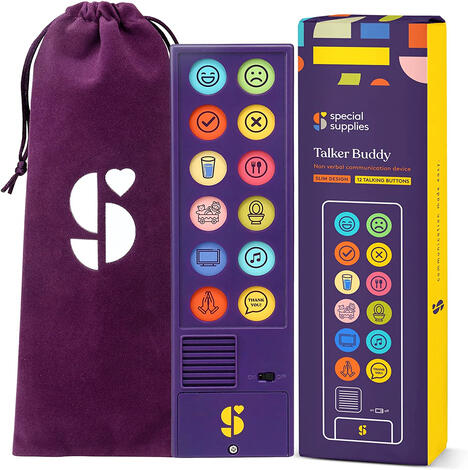
Where to buy: Amazon
Price: $19.99
Performance skills addressed:Discloses: "Reveals opinions, feelings, and private information about self or others in a socially appropriate manner" (OTPF-4, p. 48). The AAC Talker Buddy allows adolescents who struggle voicing their feelings, needs, and wants by pressing a button. While some teens become increasingly agitated by not being able to communicate these things properly, this device allows them to communicate clearly and be easily understood when disclosing information.Expresses emotions: "Displays affect and emotions in a socially appropriate manner" (OTPF-4, p.48). Much like disclosing, the Talker Buddy helps these children voice their emotions clearly and concisely to be understood. Adolescents with ASD often struggle to voice their emotions and become agitated when no one understands how they are indirectly trying to communicate so this device enables them to be direct and state how they are feeling.Manipulates: "Uses dexterous finger movements, without evidence of fumbling, when manipulating task objects" (OTPF-4, p.43). Adolescents with ASD often have difficulty with fine motor movements and manipulating objects in their hands. The Talker Buddy works on manipulation as they have to hold it in their hand and manipulate the remote to press the right button.Client factors addressedMemory: The talker buddy helps improve short-term and long-term memory because teens with ASD have to remember what each button means in order to communicate with the remote.Psychosocial: "General mental functions, as they develop over the life span, required to understand and constructively integrate the mental functions that lead to the formation of the personal and interpersonal skills needed to establish reciprocal social interactions, in terms of both meaning and purpose" (OTPF-4, p.52). Adolescents who use this remote are working on their social interactions which makes them more socially acceptable. It enables them to converse with others in an appropriate manner where they may have had difficulty before.Touch functions: The buttons on the remote are smooth which may have a soothing effect on the adolescent. While the child manipulates the remote in their hand, they are increasing their touch functions as they get used to the textures on the remote.Goal:The client will be able to utilize the device to verbalize emotions and needs in 4/5 trials within 6 weeks.
Fun and Function Noise Reduction Headphones
What are noise reduction headphones?Noise reduction headphones are lightweight headphones that block out loud and extra noises but allow people to hear and participate in nearby conversations. They minimize noisy environments which can be overwhelming for adolescents with ASD who display auditory defensiveness. A scholarly article reads, "Children with ASD who have auditory hyper-reactivity (ASD-AH) are bothered by auditory stimuli that they find intolerable, therefore, it is very important to find a way to manage auditory stimuli in daily life" (Ikuta et al., 2016). These headphones help block out these noises so that individuals with ASD do not become overwhelmed by auditory stimuli and can self-regulate.
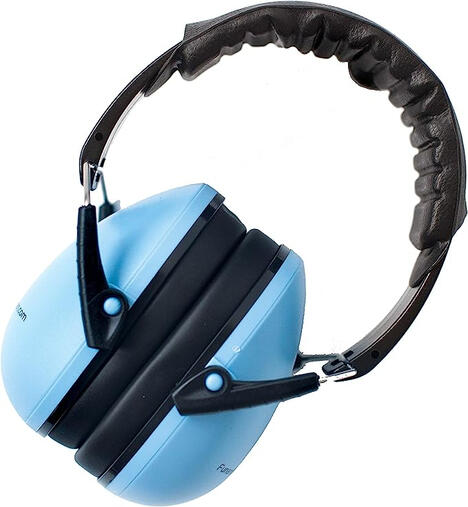
Where to buy: Amazon
Price: $28.99
Performance skills being addressed:Adjusts: "Overcomes problems with ongoing task performance effectively by (1) going to a new workspace; (2) moving task objects out of the current workspace; or (3) adjusting knobs, dials, switches, or water taps" (OTPF-4, p.46). These noise-canceling headphones help adolescents with ASD adjust to new environments; from classroom to classroom, home to school, or even in the grocery store. It helps prevent the teens from becoming overwhelmed with auditory input.Transitions (social skill): "Handles transitions in the conversation or changes the topic
without disrupting the ongoing conversation" (OTPF-4, p.48). The headphones block out excess background noise that may be a distraction to conversation and prevent disruption to the flow of conversation. Without the background noise, these adolescents can handle a smoother conversation transitioning from topic to topic without awkward pauses on inappropriate sayings or gestures.Regulates: "Does not demonstrate irrelevant, repetitive, or impulsive behaviors
during social interaction" (OTPF-4, p.48). The noise-reducing headphones help kids self-regulate by reducing noise and providing proprioception to the head. The feeling of the headphones can be deep pressure that helps them relax and regulate during social interactions.Client factors being addressed:Proprioceptive functions: This includes awareness of the body in space and deep pressure on parts of the body. The headphones help assist this because the pressure from the headphones can produce that deep pressure that can help be self-regulating. The proprioceptive input can help the adolescent get through the day and perform occupations that are needed and expected of them.Hearing functions: "Sound detection and discrimination; awareness of location and
distance of sounds" (OTPF-4, p.52). These headphones help muffle sounds for adolescents with ASD that have difficulties with loud and excessive noises. With these, they can stay more calm due to the decreased noise.Temperament and personality: "Extroversion, introversion, agreeableness, conscientiousness, emotional stability, openness to experience, self-control, self-expression, confidence, motivation, impulse control, appetite" (OTPF-4, p.52).Goal:The client will wear the headphones to self-regulate in a noisy environment (school cafeteria, school bus, grocery store, etc.) 4/5 trials within 5 weeks.
Air-filled Cushions
What are air-filled cushions?Air-filled cushions are slanted cushions filled with air that people sit on to help with posture, balance, and sensory needs. A scholarly article reads, "In addition, children with ASD show alternations in attention, including impaired disengagement and orienting of attention, overly focused and narrow attention, and a decreased ability to filter distractors" (Ridderinkhof et al., 2018). Adolescents who have difficulties with attention and sensory processing may find these air-filled cushions helpful as these cushions give people movement and stimulation to help with their focus without having to stop a task and walk around.
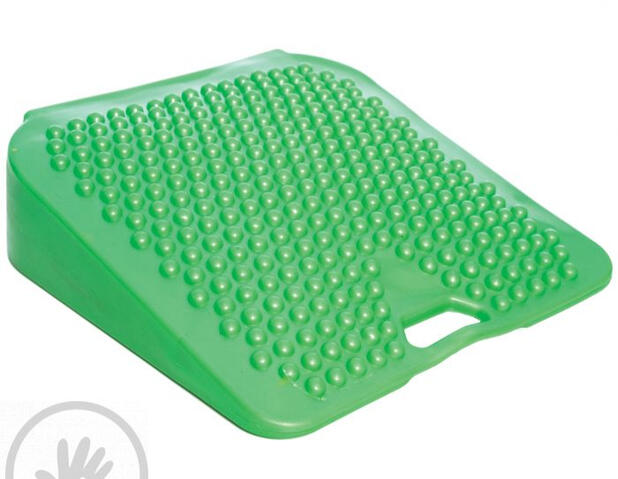
Where to buy: FunandFunction.com
Price: $31.49
Performance skills being addressed:Stabilizes: "Moves through task environment and interacts with task objects without momentary propping or loss of balance" (OTPF-4, p.43). The slanted sensory seat cushion can help the adolescent with stabilizing and with balance as it can be trickier to sit on a slant rather than an even surface. Actively engaging the core for stabilization will ultimately help balance and postural control that adolescents with ASD may be missing.Paces: "Maintains a consistent and effective rate or tempo of performance throughout the entire task performance" (OTPF-4, p.44). The sensory seat cushion can help with pacing as it gives vestibular input that can keep the individual occupied and into the task at hand, getting through the task at a steady pace.Bends: "Flexes or rotates trunk as appropriate when sitting down or when bending to grasp or place task objects that are out of reach" (OTPF-4, p.43). The seat cushion can help the adolescent with bending as it provides more vestibular input and engages the core more than a regular seat would.Client factors being affected:Vestibular functions: "Sensation related to position, balance, and secure movement
against gravity" (OTPF-4, p.52). Using the sensory cushion will provide constant vestibular input that a teen with ASD may be seeking or need in order to focus in school or during tasks.Attention: "Sustained shifting and divided attention, concentration, distractibility" (OTPF-4, p.52). Vestibular input can help improve attention and concentration that these adolescents may struggle with. Sitting on a sensory cushion like this can help these individuals receive the input they need in order to complete tasks without losing focus.Muscle endurance: "Sustainability of muscle contraction" (OTPF-4, p.53). While using a slanted cushion, the person's muscles in the thighs and cores are actively being engaged to keep them upright. Due to this, the cushion is actively working on muscle endurance and stamina for these teens with ASD.Goal
The client will complete a 25-minute classroom activity with no breaks or interruptions in 4/5 trials within 3 weeks.
Weighted Vest
What are weighted vests?Weighted vests are vests with some sort of heavy material or weights sewn into them to add weight to the upper half of the body. A weighted vest should never exceed more than 10% of a person's body weight and should be monitored closely how much it is worn. It is recommended that a vest is worn for only 15 minutes to an hour at a time. A scholarly article reads, "Children with autism are at high risk for self-regulation difficulties because of language delays and emotion-regulation difficulties" (Nuske et al., 2020). Adolescents with ASD often struggle with self-regulation which tends to lead to them becoming overwhelmed. Weighted vests help provide proprioception that is calming to the body and can help the teen self-regulate by themselves before the feeling of being overwhelmed gets out of hand.
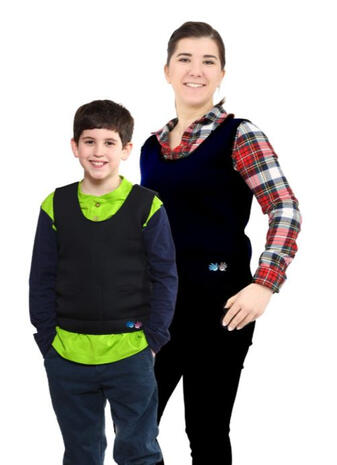
Where to buy: FunandFunction.com
Price: $78.99
Performance skills being addressed:Calibrates: "Uses movements of appropriate force, speed, or extent when interacting with task objects (e.g., does not crush task objects, pushes a door with enough force to close it without a bang) (OTPF-4, p.44). Weighted vests help with calibration because it gives the teen a better sense of where their body is and space and what their body's capabilities are.Continues: "Performs single actions or steps without any interruptions so that once an action or task step is initiated, performance continues without pauses or delays until the action or step is completed" (OTPF-4, p.45). The weighted vests can help assist the individual continue one task at a time with no interruptions as it increases attention which helps them focus on one task at a time.Organizes: "Logically positions or spatially arranges task objects in an orderly fashion within a single workspace or between multiple appropriate workspaces such that the workspace is not too spread out or too crowded" (OTPF-4, p.46).Client factors being addressedProprioceptive functions: "Awareness of body position and space" (OTPF-4, p.52). The weighted vest provides a deep-pressure sensation that is organizing and calming to the body.Thought: "Control and content of thought, awareness of reality vs. delusions, logical and coherent thought" (OTPF-4, p.52). As proprioception calms the body, it causes the individual's thoughts to become clearer and less disorganized and overwhelmed.Attention: "Sustained shifting and divided attention, concentration, distractibility" (OTPF-4, p.52). Weighted vests help adolescents with their attention span, allowing them to focus more on one task at a time for several minutes whereas without the deep-pressure input, they may not be able to focus their attention on a task for long enough to complete it.Goal:The child will be able to self-regulate by wearing the vest in a classroom setting when becoming overwhelmed in 4/5 trials within 4 weeks.
LiveScribe Smart Pen
What is the LiveScribe Smart Pen?LiveScribe Smart pens allow individuals to record and replay everything they hear, write, and say at a given time. The audio can be played back directly on the pen or on your phone or smart device when needed. It also allows people to convert their handwriting to text so that their notes can be online as well. A scholarly article reads, "...children with ASD show worse quality of forming letters but do not show differences in their ability to correctly size, align, and space their letters" (Fuentes et al., 2009). Adolescents with ASD often have difficulties with handwriting and due to this, they struggle to take notes and fulfill their role as a student. The Smart Pen helps this problem by allowing them to record class lessons and allowing it to be transferred onto a laptop or other smart device without missing any important information.
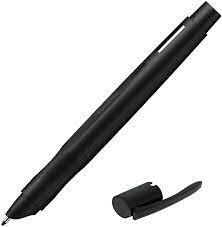
Where to buy: Livescribe.com
Price: $119.95
Performance skills being addressed:Grips: "Effectively pinches or grasps task objects such that the objects do not slip (e.g., from between fingers, from between teeth, from between hand and supporting surface) (OTPF-4, p.43). The LiveScribe Smart Pen allows the adolescent to work on correctly positioning and gripping the pen in a correct writing position.Paces: "Maintains a consistent and effective rate or tempo of performance throughout the entire task performance (OTPF-4, p.45). The Smart Pen allows students to pace themselves as they take notes, taking the edge off of "what if I miss something?" Knowing that they can listen back to the lecture and write down things they may have missed will help them improve their pacing rather than falling behind or rushing.Flows: "Uses smooth and fluid arm and wrist movements when interacting with task objects" (OTPF-4, p.44). The use of the smart pen can help the child's fluidity while writing and taking notes. It allows them to move at a slower pace and focus on writing in fluid movements rather than rushing and using jerky and awkward movements.Client factors being addressedThought: "Control and content of thought, awareness of reality vs. delusions, logical and coherent thought" (OTPF-4, p.52). The LiveScribe Smart Pen helps organize thoughts so that they can stay more coherent with information being taught or given to the adolescent.Perception:Control of voluntary movement: " Eye–hand and eye–foot coordination, bilateral integration, crossing of the midline, fine and gross motor control, oculomotor function (e.g., saccades, pursuits, accommodation, binocularity)" (OTPF-4, p.53). Writing with this pen helps teens improve their hand-eye coordination as well as bilateral coordination as writing can use both hands for one purpose--one holding the paper and one holding the pen. The person will develop better control of voluntary movement by using the pen.Goal:The client will complete note-taking for 25 minutes with an even pace for 4/5 trials within 4 weeks.

Remedial Activities
Here, you will discover a list of remedial activities that can be done at home, at school, and in other settings to help improve the performance skills and client factors of adolescents with ASD. You, yourself, can perform and help your teen with these activities.
Emotion Charades
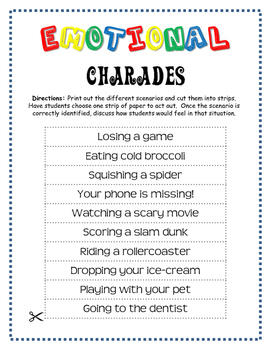
Emotion charades is a free and easy activity that can be done with adolescents with ASD at any age between 13-18. This activity focuses on helping these individuals express different types of emotions that are suitable for the everyday situations presented in the activity.For this specific emotion charades game, the caregiver would print out the activity and cut along the dotted lines to cut the everyday situations into strips. You can either fold them up or lay them face down so the adolescent cannot see the scenario and have them pick one. Once they have picked, they will have to portray the scenario through facial expressions and body language. Others involved can try to guess what the everyday situation is based on the individual's presentation! Keep going until the adolescent has acted out 5 scenarios. For a follow-up discussion for the activity, have the teen try to explain what cues they used for different scenarios and why.If this activity is too easy for your child, grade it up by having them act out 8 scenarios instead of 5.
If it is too difficult for your child, grade down by having them act out 3 scenarios instead of 5.
How does this activity help the individual?The main focus of this activity is to focus on expressing emotions and communicating properly. Many individuals struggle with expressing themselves so emotional charades is a fun and easy activity to practice and engage them. A scholarly article reads, "Several studies have found a delay in the development of facial emotion recognition and expression in children with an autism spectrum condition" (Lecciso et al., 2021). It is well-known that individuals with ASD from childhood into adulthood struggle with recognizing and displaying emotions so this activity focuses on this deficit and can promote proper understanding and utilizing facial expressions and body language to show emotions.Below are charts of other performance skills and client factors that this activity can help improve:
| Performance skills | |
|---|---|
| Paces | Maintains a consistent and effective rate or tempo of performance throughout the entire task performance |
| Chooses | Selects necessary and appropriate type and number of objects for the task, including the task objects that one chooses or is directed to use |
| Continues | Performs single actions or steps without any interruptions so that once an action or task step is initiated, performance continues without pauses or delays until the action or step is completed |
| Navigates | Moves body or wheelchair without bumping into obstacles when moving through the task environment or interacting with task objects |
| Notices/responds | Responds appropriately to (1) nonverbal task-related cues (e.g., heat, movement), (2) the spatial arrangement and alignment of task objects to one another, and (3) cupboard doors or drawers that have been left open during task performance |
| Gesticulates | Uses socially appropriate gestures to communicate or support a message |
| Turns toward | Actively positions or turns body and face toward the social partner or the person who is speaking |
| Regulates | Does not demonstrate irrelevant, repetitive, or impulsive behaviors during social interaction |
| Expresses emotions | Displays affect and emotions in a socially appropriate manner |
| Heeds | Uses goal-directed social interactions focused on carrying out and completing the intended purpose of the social interaction |
Retrieved from (OTPF-4, 2020, pgs.45-49)
| Client Factors | |
|---|---|
| Higher level of cognitive function | Judgment, concept formation, metacognition, executive functions, praxis, cognitive flexibility, insight |
| Attention | Sustained shifting and divided attention, concentration, distractibility |
| Mental functions of sequencing complex movement | Mental functions that regulate the speed, response, quality, and time of motor production, such as restlessness, toe tapping, or hand wringing, in response to inner tension |
| Emotional | Regulation and range of emotions; appropriateness of emotions, including anger, love, tension, and anxiety; lability of emotions |
| Psychosocial | General mental functions, as they develop over the life span, required to understand and constructively integrate the mental functions that lead to the formation of the personal and interpersonal skills needed to establish reciprocal social interactions, in terms of both meaning and purpose |
| Temperament and personality | Extroversion, introversion, agreeableness, conscientiousness, emotional stability, openness to experience, self-control, self expression, confidence, motivation, impulse control, appetite |
Retrieved from (OTPF-4, 2020, p.52)
Making Cinammon Rolls with a Visual Recipe
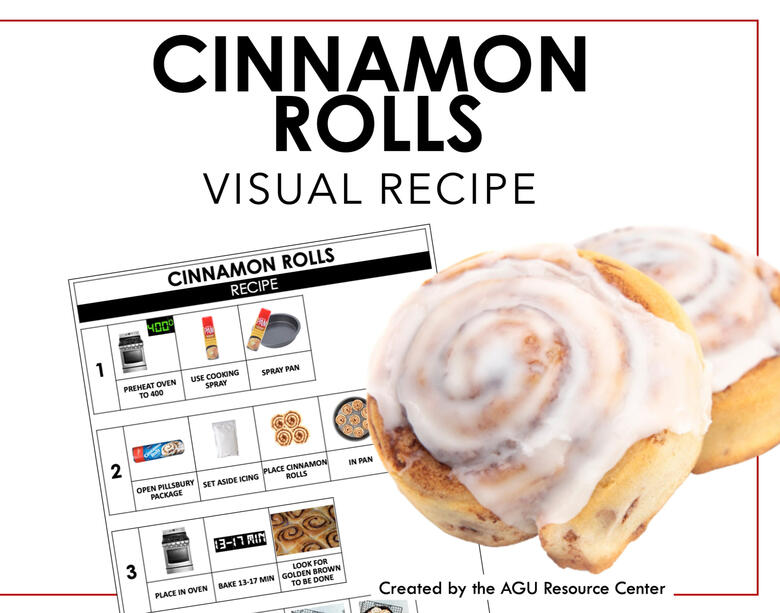
For this activity, the adolescent will help the family member make Pillsbury cinnamon rolls in the oven by following a visual recipe. To do this, the cinnamon rolls will be pre-bought and in the fridge.
First, the adolescent will look over the visual recipe to see what they will need. Next, they will locate the cinnamon rolls in the fridge and bring them to the counter. They will also locate the cooking spray, pan, and other items needed to make the cinnamon rolls. Before opening anything, they will tell their cooking partner what degrees to set the oven to.
They will next go step by step along with the directions; opening and placing the cinnamon rolls evenly on the baking sheet as instructed.
They will also be required to give the time needed to bake the cinnamon rolls.
Once they are out of the oven, the teenager will ice the cinnamon rolls and identify the ending of the instructions.If this activity is too easy for your child, grade it up by having the adolescent go to the grocery store and find the cinnamon rolls that are needed for this activity.
If it is too difficult for your child, grade down by having the teenager only do the preparatory steps (before they are baked).
How does this activity help the individual?This activity focuses on a variety of different performance skills and client factors for adolescents. An article reads, "...reading comprehension difficulties of children with ASD derive from oral language limitations" (Vale et al., 2022). As mentioned on this site, adolescents with ASD often have oral language difficulties which can also impact the way they read and comprehend what they are reading. Having a visual recipe can help be a better guide as the pictures can provide clearer instructions along with the simple word instructions so that these teens can have an easier time following the recipe.Below are charts of other performance skills and client factors that this activity can help improve:
| Performance Skills | |
|---|---|
| Aligns | Interacts with task objects without evidence of persistent propping or leaning |
| Poisitions | Positions self an effective distance from task objects and without evidence of awkward arm or body positions |
| Manipulates | Uses dexterous finger movements, without evidence of fumbling, when manipulating task objects |
| Coordinates | Uses two or more body parts together to manipulate and hold task objects without evidence of fumbling or task objects slipping from the grasp |
| Endures | Persists and completes the task without demonstrating physical fatigue, pausing to rest, or stopping to catch breath |
| Attends | Does not look away from task performance, maintaining the ongoing task progression |
| Heeds | Carries out and completes the task originally agreed on or specified by another person |
| Inquires | (1) Seeks needed verbal or written information by asking questions or reading directions or labels and (2) does not ask for information when fully oriented to the task and environment and recently aware of the answer |
| Sequences | Performs steps in an effective or logical order and with an absence of randomness in the ordering or inappropriate repetition of steps |
| Searches/locates | Looks for and locates task objects in a logical manner |
| Organizes | Logically positions or spatially arranges task objects in an orderly fashion within a single work space or between multiple appropriate work spaces such that the work space is not too spread out or too crowded |
| Accomodates | Prevents ineffective performance of all other motor and process skills and asks for assistance only when appropriate or needed |
| Regulates | Does not demonstrate irrelevant, repetitive, or impulsive behaviors during social interaction |
Retrieved from (OTPF-4, 2020, pgs.43-48)
| Client Factors | |
|---|---|
| Higher level of cognitive function | Judgment, concept formation, metacognition, executive functions, praxis, cognitive flexibility, insight |
| Attention | Sustained shifting and divided attention, concentration, distractibility |
| Memory | Short-term, long-term, and working memory |
| Mental functions of sequencing complex movement | Mental functions that regulate the speed, response, quality, and time of motor production, such as restlessness, toe tapping, or hand wringing, in response to inner tension |
| Temperament and personality | Extroversion, introversion, agreeableness, conscientiousness, emotional stability, openness to experience, self-control, self expression, confidence, motivation, impulse control, appetite |
| Visual functions | Quality of vision, visual acuity, visual stability, and visual field functions to promote visual awareness of the environment at various distances for functioning |
Retrieved from (OTPF-4, 2020, p.52)
Nature Walks
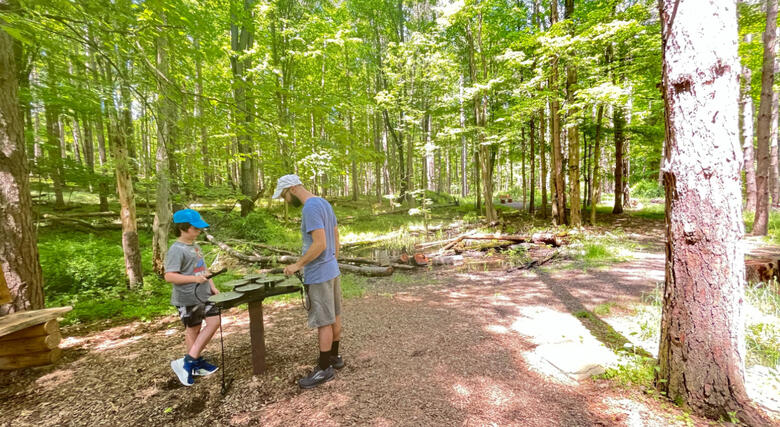
This activity is simple-Go outside and enjoy nature! Pick a short trail that is less than a half mile long and is not too hard to navigate. Stay close to the adolescent to avoid any accidents or injuries and walk along the trail with them. Point out things you see along the way and the noises you hear, and engage them in simple conversation as you walk along the nature trail.If this activity is too easy for your child, grade it up by picking a more challenging hiking trail (ex. a trail with hills).
If it is too difficult for your child, grade down by picking a .25 mile trail rather than a .5 mile trail.
How does this activity help the individual?Nature walks are a simple way to engage the adolescent in physical activity as well as social interactions. A scholarly article reads, "Results showed that exposure to nature provided motor-sensory, emotional and social benefits to children with ASD..." (Li et al., 2019). Taking the teens on nature walks can be beneficial to the areas listed in the article because they help reduce stress and anxiety levels in individuals with ASD. Walking on uneven surfaces, jumping over logs, and navigating their way along the trail provides vestibular input as well as proprioceptive feedback with helps regulate and calm the body. Along with this, nature walks help increase problem-solving skills as well as social interaction skills as they walk with their caregiver and/or families and navigate along the path.Below are charts of other performance skills and client factors that this activity can help improve:
| Performance Skills | |
|---|---|
| Stabilizes | Moves through task environment and interacts with task objects without momentary propping or loss of balance |
| Positions | Positions self an effective distance from task objects and without evidence of awkward arm or body positions |
| Walks | During task performance, ambulates on level surfaces without shuffling feet, becoming unstable, propping, or using assistive devices |
| Endures | Persists and completes the task without demonstrating physical fatigue, pausing to rest, or stopping to catch breath |
| Paces | Maintains a consistent and effective rate or tempo of performance throughout the entire task performance |
| Heeds | Carries out and completes the task originally agreed on or specified by another person |
| Navigates | Moves body or wheelchair without bumping into obstacles when moving through the task environment or interacting with task objects |
| Accommodates | Prevents ineffective performance of all other motor and process skills and asks for assistance only when appropriate or needed |
| Regulates | Does not demonstrate irrelevant, repetitive, or impulsive behaviors during social interaction |
Retrieved from (OTPF-4, 2020, pgs.43-48)
| Client Factors | |
|---|---|
| Higher level of cognitive function | Judgment, concept formation, metacognition, executive functions, praxis, cognitive flexibility, insight |
| Attention | Sustained shifting and divided attention, concentration, distractibility |
| Perception | Discrimination of sensations (e.g., auditory, tactile, visual, olfactory, gustatory, vestibular, proprioceptive) |
| Mental functions of sequencing complex movement | Mental functions that regulate the speed, response, quality, and time of motor production, such as restlessness, toe tapping, or hand wringing, in response to inner tension |
| Emotional | Regulation and range of emotions; appropriateness of emotions, including anger, love, tension, and anxiety; lability of emotions |
| Psychosocial | General mental functions, as they develop over the life span, required to understand and constructively integrate the mental functions that lead to the formation of the personal and interpersonal skills needed to establish reciprocal social interactions, in terms of both meaning and purpose |
| Temperament and personality | Extroversion, introversion, agreeableness, conscientiousness, emotional stability, openness to experience, self-control, self expression, confidence, motivation, impulse control, appetite |
| Energy | Energy level, motivation, appetite, craving, impulse |
| Vestibular functions | Sensation related to position, balance, and secure movement against gravity |
| Proprioceptive functions | Awareness of body position and space |
Retrieved from (OTPF-4, 2020, p.52)
Storytelling Improvisation

This activity is impromptu storytelling that can help adolescents with ASD use their imagination and develop their logical thinking capabilities. The way it works is simple: the parent/caregiver will begin the story with one sentence, such as, "One day, a fairy went deep into the woods..." Then, it is the adolescent's turn to complete the sentence and add to the story. Once they take their turn, the caregiver will then do the next line and that rotation will continue; both taking turns and adding to the story. Allow them to take the story wherever they would like, allowing them to be spontaneous and creative which in turn will also boost their confidence. Do the activity for 15 minutes and finish when you reach "The End!"If this activity is too easy for your child, grade it up by increasing the length of time from 15 minutes to 20 minutes.
If it is too difficult for your child, grade down by decreasing the time from 15 minutes to 10 minutes.
How does this activity help the individual?This activity focuses on improving logical thinking skills and decision-making in adolescents with ASD as well as social interaction skills. An article reads, "Decisions were difficult to make for people with ASD if they involved talking to others; involved a change in routine; or if the decision has to be made quickly" (Brosnan et al., 2016). Decision-making and thinking logically can be difficult for teenagers with ASD as it typically puts them on the spot. Practicing these skills with impromptu storytelling will help build these skills without the pressure of a real-life situation that needs a decision. During the storytelling, these individuals will have to decide where they want the story to go and if it makes sense with the rest of the story; increasing both decision-making skills and logical thinking.Below are charts of other performance skills and client factors that this activity can help improve:
| Performance Skills | |
|---|---|
| Paces | Maintains a consistent and effective rate or tempo of performance throughout the entire task performance |
| Continues | Performs single actions or steps without any interruptions so that once an action or task step is initiated, performance continues without pauses or delays until the action or step is completed |
| Accommodates | Prevents ineffective performance of all other motor and process skills and asks for assistance only when appropriate or needed |
| Produces speech | Produces spoken, signed, or augmentative (i.e., computer-generated) messages that are audible and clearly articulated |
| Turns towards | Actively positions or turns body and face toward the social partner or the person who is speaking |
| Regulates | Does not demonstrate irrelevant, repetitive, or impulsive behaviors during social interaction |
| Replies | Keeps conversation going by replying appropriately to suggestions, opinions, questions, and comments |
| Transitions | Handles transitions in the conversation or changes the topic without disrupting the ongoing conversation |
| Takes turns | Speaks in turn and gives the social partner the freedom to take their turn |
| Matches language | Uses a tone of voice, dialect, and level of language that are socially appropriate and matched to the social partner’s abilities and level of understanding |
Retrieved from (OTPF-4, 2020, pgs.43-48)
| Client Factors | |
|---|---|
| Higher level of cognitive function | Judgment, concept formation, metacognition, executive functions, praxis, cognitive flexibility, insight |
| Attention | Sustained shifting and divided attention, concentration, distractibility |
| Memory | Short-term, long-term, and working memory |
| Thought | Control and content of thought, awareness of reality vs. delusions, logical and coherent thought |
| Mental functions of sequencing complex movement | Mental functions that regulate the speed, response, quality, and time of motor production, such as restlessness, toe tapping, or hand wringing, in response to inner tension |
| Temperament and personality | Extroversion, introversion, agreeableness, conscientiousness, emotional stability, openness to experience, self-control, self expression, confidence, motivation, impulse control, appetite |
Retrieved from (OTPF-4, 2020, p.52)
Paint with Ice
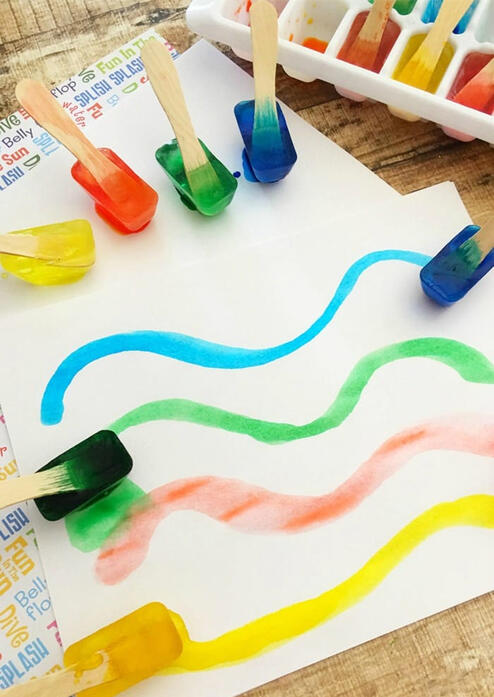
This activity is budget friendly and engaging for adolescents with ASD! All you need for this activity is an ice tray, water, water paints, and craft sticks. For this activity, the caregiver will prepare the ice paints by mixing water and the paints and pouring them into an ice tray. You can insert the craft sticks and leave some without craft sticks in case your child likes the cold temperature. Let the ice freeze for at least 2 hours before setting up the table for your child to paint. Set down a plastic tablecloth to protect your table, make sure the chair is the correct height (their feet can touch the floor), and give them enough paper to paint until they are satisfied! Engage them by painting with them and giving them various colors to choose from!If this activity seems too easy for your child, grade it up by having them prepare the paints with you.
If it seems that it is too difficult, grade it down by giving them fewer colors to choose from, giving them fewer options which will make the activity easier for them.
How does this activity help the individual?This activity helps these teens with ASD in numerous ways. For starters, it allows them to open up their imagination and be creative by drawing whatever they want. It can also help provide tactile input if they use the ice cubes without the art sticks. The cold and smoothness of the ice can provide that tactile input they may be seeking and can be calming to the body. Painting with ice can also help increase fine motor skills. An article reads, "ASD patients showed less efficient eye-hand coordination, which was particularly evident when pointing toward a target was being fixated" (Crippa et al., 2012). Painting helps improve fine motor skills as the individual has to grip the ice cube or stick and guide it around the paper in order to make a drawing. This leads to increased eye-hand coordination as it is detrimental to drawing. The more they do this activity, the more their eye-hand coordination will increase.Below are charts of other performance skills and client factors that this activity can help improve:
| Performance Skills | |
|---|---|
| Positions | Positions self an effective distance from task objects and without evidence of awkward arm or body positions |
| Reaches | Effectively extends arm and, when appropriate, bends trunk to effectively grasp or place task objects that are out of reach |
| Bends | Flexes or rotates trunk as appropriate when sitting down or when bending to grasp or place task objects that are out of reach |
| Grips | Effectively pinches or grasps task objects such that the objects do not slip (e.g., from between fingers, from between teeth, from between hand and supporting surface) |
| Manipulates | Uses dexterous finger movements, without evidence of fumbling, when manipulating task objects |
| Flows | Uses smooth and fluid arm and wrist movements when interacting with task objects |
| Chooses | Selects necessary and appropriate type and number of objects for the task, including the task objects that one chooses or is directed to use |
| Uses | Applies task objects as they are intended |
| Sequences | Performs steps in an effective or logical order and with an absence of randomness in the ordering or inappropriate repetition of steps |
Retrieved from (OTPF-4, 2020, pgs.43-46)
| Client Factors | |
|---|---|
| Higher level of cognitive function | Judgment, concept formation, metacognition, executive functions, praxis, cognitive flexibility, insight |
| Attention | Sustained shifting and divided attention, concentration, distractibility |
| Perception | Discrimination of sensations (e.g., auditory, tactile, visual, olfactory, gustatory, vestibular, proprioceptive) |
| Mental functions of sequencing complex movement | Mental functions that regulate the speed, response, quality, and time of motor production, such as restlessness, toe tapping, or hand wringing, in response to inner tension |
| Temperament and personality | Extroversion, introversion, agreeableness, conscientiousness, emotional stability, openness to experience, self-control, self expression, confidence, motivation, impulse control, appetite |
| Vestibular functions | Sensation related to position, balance, and secure movement against gravity |
| Visual functions | Quality of vision, visual acuity, visual stability, and visual field functions to promote visual awareness of the environment at various distances for functioning |
| Touch functions | Feeling of being touched by others or touching various textures, such as those of food; presence of numbness, paresthesia, hyperesthesia |
Retrieved from (OTPF-4, 2020, pgs.52-53)